
Published by Zempo. This article includes promotion of Zempo’s software; its author is Zempo’s founder.
Planning household spending in Dubai
The salary comes in, so where does it all go? Rent might leave monthly or in a few large cheques, school fees arrive in terms, and everyday spending builds up across cards and accounts. It can be hard to see what is genuinely available to spend when some of that money needs to cover a bill that has not arrived yet.
This guide covers four practical budgeting habits: understanding your regular costs, reviewing larger expenses, discussing shared commitments and planning ahead for bills and savings. The examples are ways to organise information; the amounts and choices will depend on your household.
Start with a short review and return to it regularly. The time needed will depend on how many accounts and commitments you manage.
Step 1: Know your real monthly number
The cost of living in Dubai varies with household size, housing, schooling and everyday choices. Published averages can give context, while your own records show the costs you need to plan for.
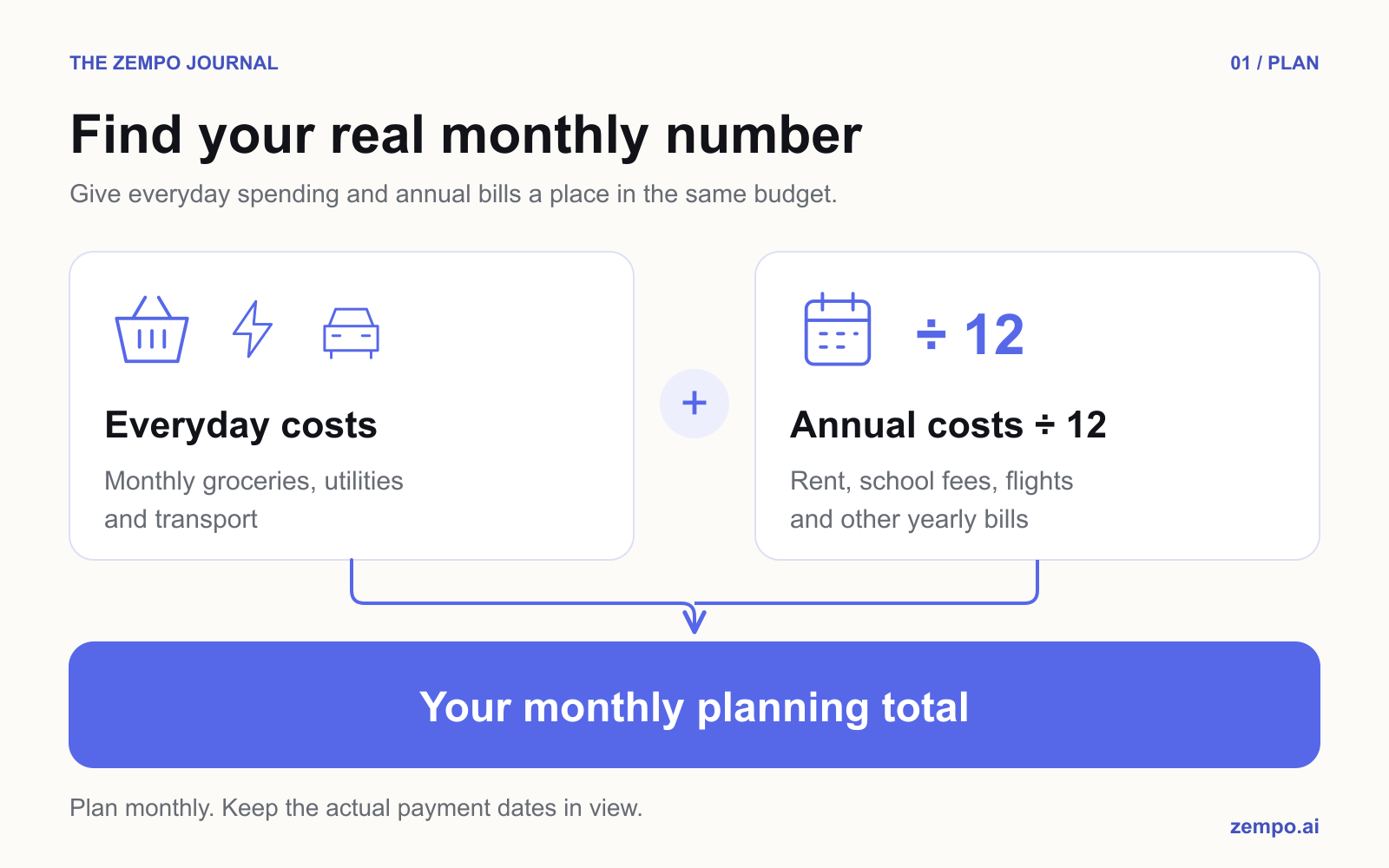
Take your last three months of bank and card statements and sort every outgoing into the categories below. Use annual costs divided by 12 to understand the monthly cost of your lifestyle, then list the actual payment amounts and due dates. A monthly average alone will not tell you whether you have enough ready for the next rent cheque.
| Category | Monthly (AED) | Notes |
|---|---|---|
| Rent (yearly ÷ 12) | Track payment amounts and due dates separately; allow for any payment-plan fees. | |
| School fees (yearly ÷ 12) | Plus uniforms, transport and trips | |
| DEWA, chiller, internet, mobile | Check seasonal usage and any separate cooling charges. | |
| Car: finance, insurance, fuel, Salik, parking | Registration and servicing ÷ 12 | |
| Groceries | Every supermarket and delivery app | |
| Eating out and delivery | Include delivery and service charges. | |
| Helper or childcare | Salary, visa and flights ÷ 12 | |
| Subscriptions | Streaming, gym, apps, memberships | |
| Flights home and holidays (yearly ÷ 12) | Include planned fares, baggage and other travel costs. | |
| Sending money home | ||
| Everything else | ||
| Total |
Look for differences between what you expected to spend and what your records show. They can help you decide which parts of the budget to review.
Step 2: Review housing, school and transport costs
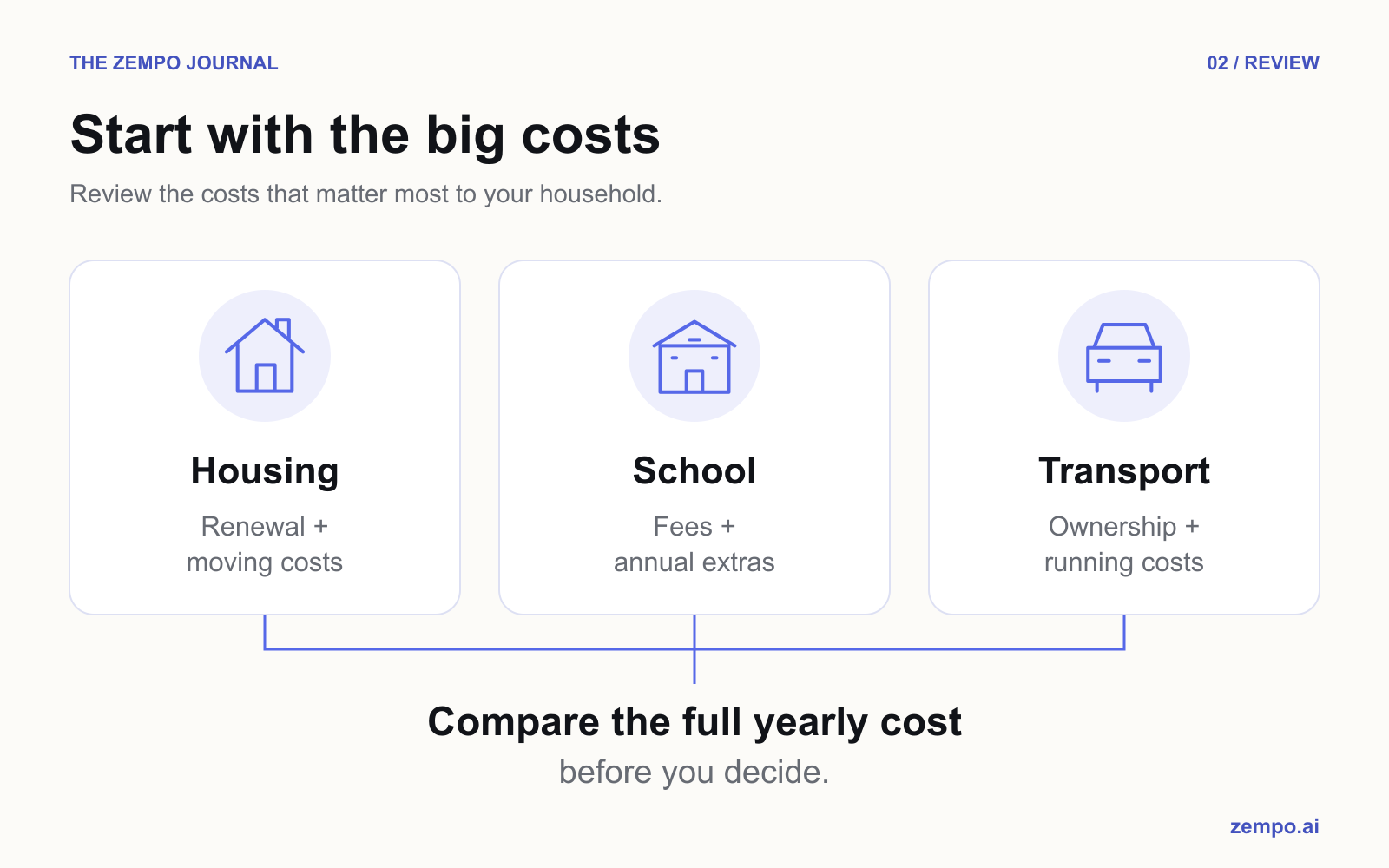
Housing, school and transport can be significant household commitments. Review the categories that account for the largest share of your own spending, alongside smaller costs you may be able to adjust.
Rent
- Before renewal, consult Dubai Land Department’s Rental Index and current tenancy guidance. Any proposed change should be checked against your contract and the rules that apply to your tenancy. Contact DLD or the Rental Disputes Center if you need clarification. View the official Rental Index.
- Compare the payment terms as well as the annual rent. Ask whether fewer cheques would reduce the price, and whether monthly payments are available. Choose a schedule you can fund without leaving yourself short for other bills.
Monthly rent is an option on some properties. Dubai Land Department’s voluntary Flexi Rent initiative allows participating companies to offer monthly, quarterly or semi-annual payments on eligible units. Separate third-party services may also spread rent into instalments. Check eligibility, fees, repayment terms and the full annual cost before deciding whether an arrangement suits you. Spreading payments does not necessarily reduce the total cost, and this guide does not recommend a rent-financing provider. Check official Flexi Rent information.
Quarterly and other cheque arrangements still matter. I pay my own rent in three cheques, so I need to plan for each payment well before it is due. The months without a cheque going out can make the bank balance look more available to spend than it really is.
For each rent payment, note the amount, due date and what you have already set aside. One planning calculation is the amount still needed divided by the paydays remaining before the due date. Compare that figure with what is affordable after your other essential commitments. If no payday remains, the payment needs to be covered from money already available; dividing by future paydays will not address that immediate shortfall.
- Compare moving costs as well as rent. Include any agency fees, deposits, utility connection costs, moving costs and changes in commuting expenses before comparing two homes.
School fees
- Check your school’s current KHDA School Fees Fact Sheet and Parent-School Contract for tuition, mandatory charges and optional extras. KHDA has announced no increase in Dubai private school fees for the 2026–27 academic year; check the current guidance when planning a later year. View the KHDA fees guide. Read the 2026–27 announcement.
- Ask about sibling discounts and early payment discounts. Not every school advertises them.
- Budget for the extras (transport, uniforms, trips, activities) at the start of the year, not term by term.
Cars
- List transport costs together: any finance repayments, insurance, fuel, Salik, parking, servicing and registration. This shows the total beyond the vehicle payment alone.
- At insurance renewal, compare the premium, cover, exclusions, excess and applicable requirements. A lower price is only one part of the comparison.
- Where practical, compare the cost and convenience of public transport, taxis or occasional rentals with the full cost of another car.
Step 3: Dubai money saving tips for everyday spending
Review everyday spending alongside the larger commitments. Choose changes that fit your household rather than assuming every category needs to be reduced.
- Groceries: compare the same basket across shops or delivery services you already use, including delivery charges. Planning meals and checking what you have at home can help avoid duplicate purchases.
- Delivery: include delivery and service charges when reviewing food spending. Use your records to decide whether a category budget would be useful.
- Utilities: DEWA’s conservation guidance recommends a summer AC setting of 24°C and auto mode, alongside regular filter cleaning. Follow suitable settings for the occupants and equipment; any reduction in use or cost will depend on your circumstances. See DEWA’s guidance.
- Subscriptions: review recurring charges and identify services you no longer need. Check cancellation terms, notice periods and any fees before making changes.
- Mobile and internet: compare renewal offers, allowances, contract length and any switching or cancellation charges.
- Entertainment: if considering a paid discount or loyalty app, compare its fee with benefits you expect to use. Avoid extra spending just to redeem an offer.
- Flights home: include planned travel in the annual budget. Compare fares, baggage, flexibility and cancellation terms; booking early or using a price alert does not guarantee the lowest fare.
Turn your spending into a budget
Advertisement for Zempo
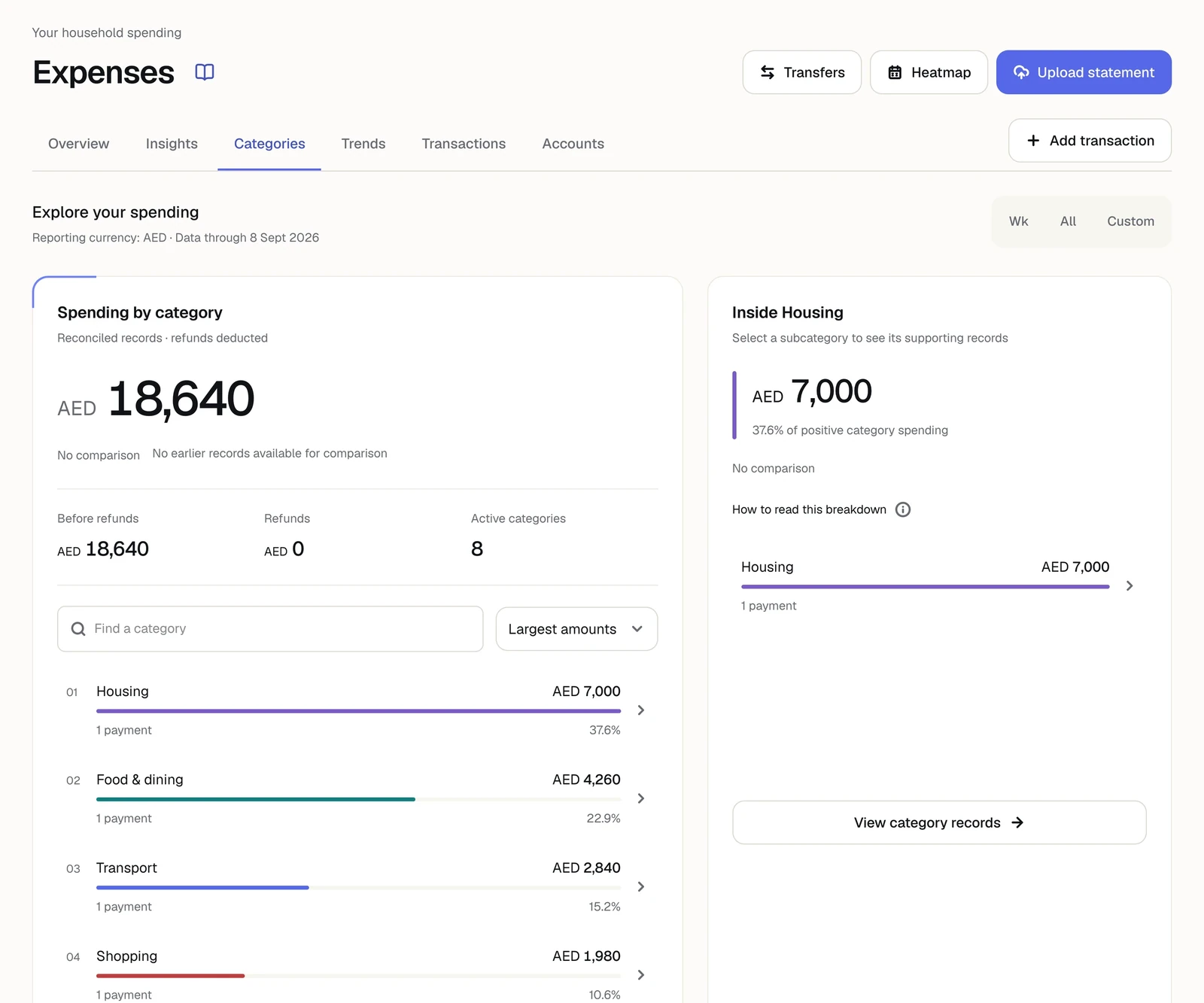
Upload a compatible bank-generated PDF statement and check the transactions and categories. Then use Zempo’s budgets to set amounts for groceries, eating out, transport and other costs, and compare your plan with the spending recorded in Zempo. You can adjust those amounts as you learn what works for your household.
No bank login required. The Free plan includes three PDF uploads in total, budgets and savings goals. Check current plan details. View plans.
Step 4: Hold a monthly money meeting (especially as a couple)
A shared money check-in can help couples understand the same household commitments while keeping separate accounts. Review the records together and agree what, if anything, needs to change.
Keep it short and keep it the same every time:
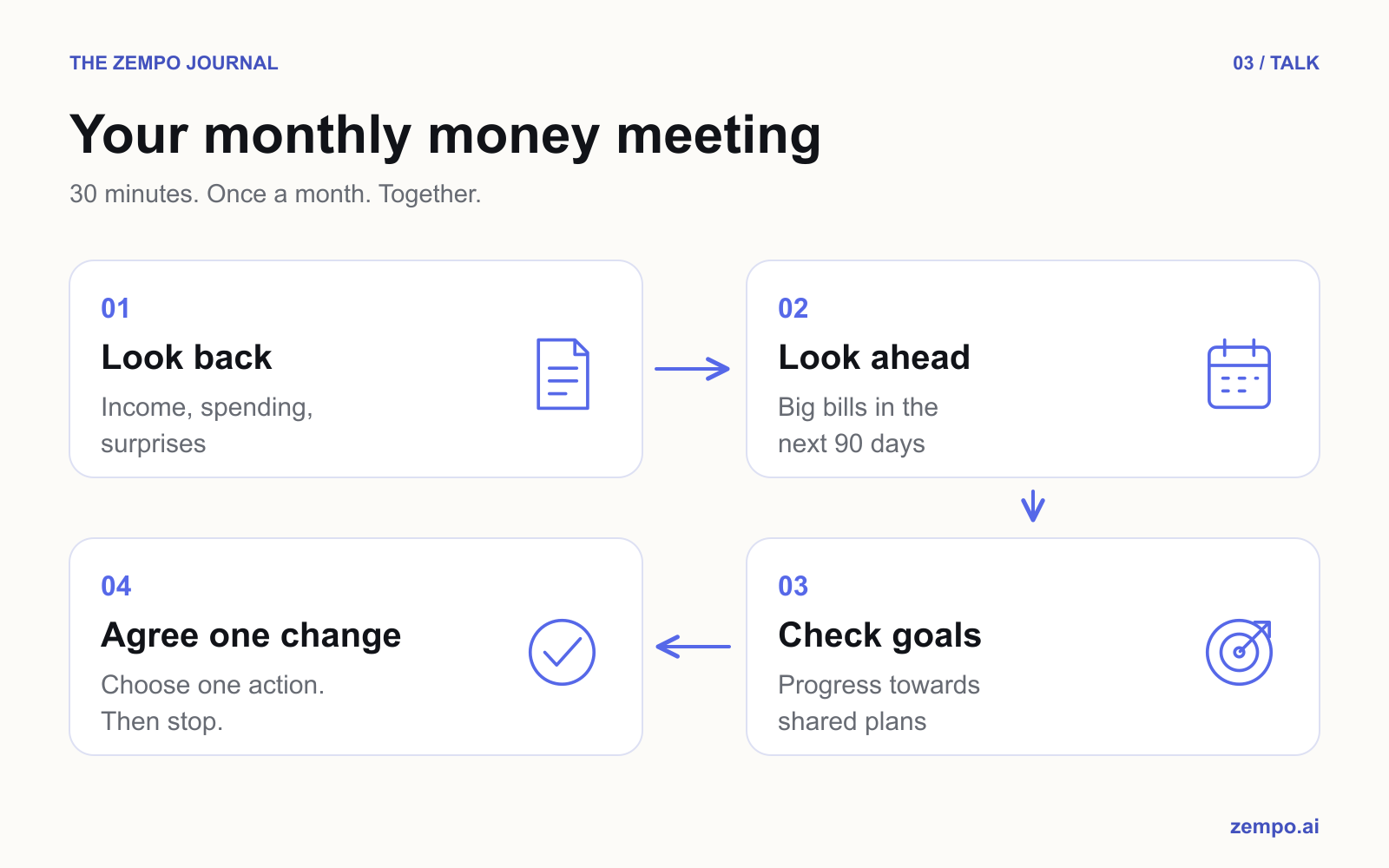
- Look back. Compare recorded spending with your category budgets. What went over, and does the spending or the budget need to change?
- Look ahead. Big costs in the next 90 days: rent cheque, school term, flights, renewals.
- Check the goals. Emergency fund, house deposit, the trip, the move home. Are you on track?
- Agree one change. Just one. Then stop.
Choose a regular time that works for everyone involved. The aim is a shared understanding of upcoming bills, spending and goals.
Step 5: Plan an affordable savings routine
A savings routine needs to fit around essential bills, debt repayments and other commitments. Review the timing as well as the amount so a transfer does not leave a shortfall before the next payday.
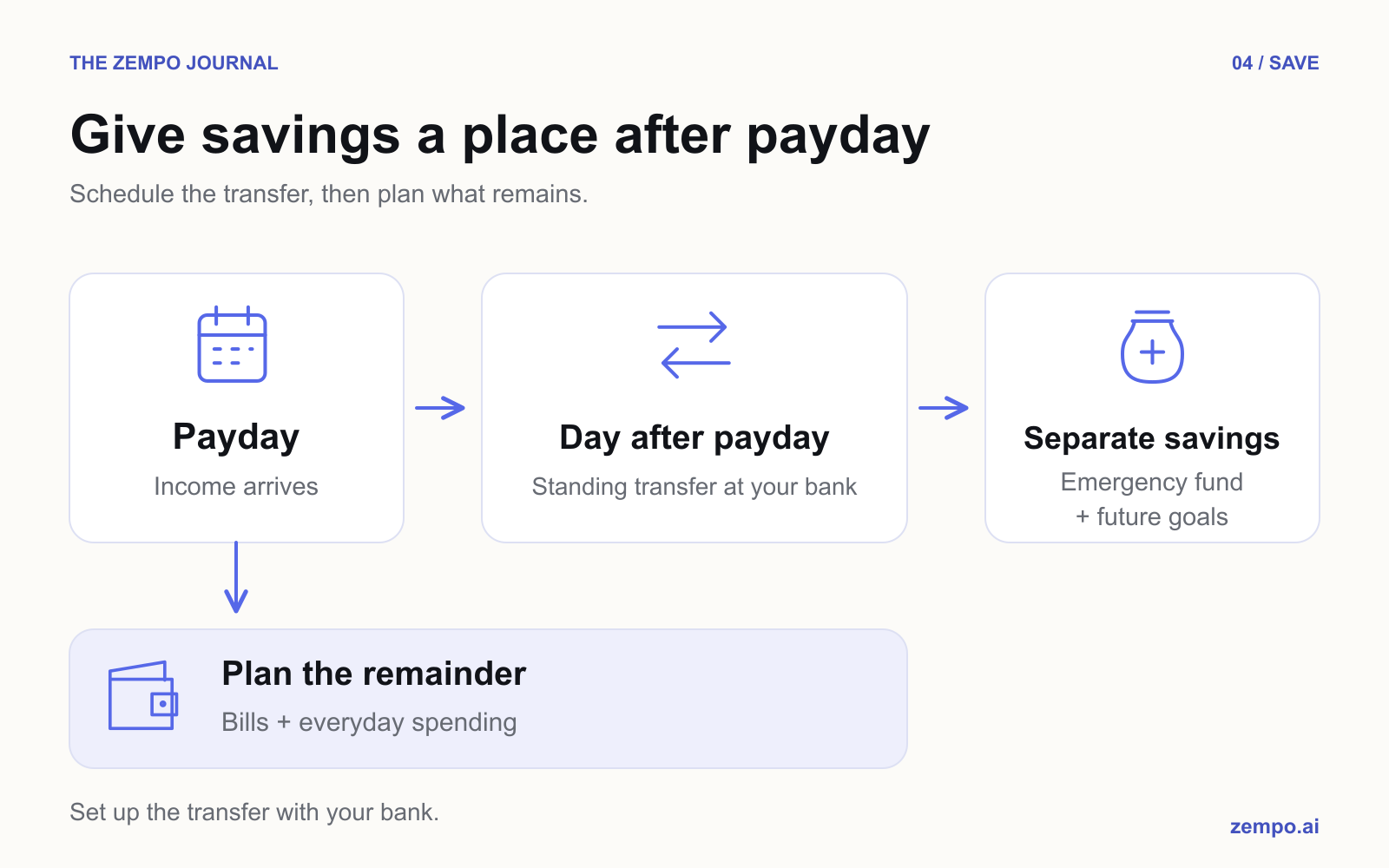
- Consider a transfer if it suits your budget. One option is a recurring transfer at your bank after income arrives. Choose an affordable amount and date, check any account terms or fees, and review it when circumstances change. The illustration below is an example, not a recommended amount, account or schedule for every household.
- Plan for unexpected costs. List the essential expenses you would need to cover if income changed or an unplanned bill arrived. The amount you choose to keep available will depend on your income, commitments and existing resources; there is no single target suitable for every household.
- Understand your employer’s arrangements. Ask HR which end-of-service, pension or savings arrangements apply to you and where to find the official terms. Check eligibility, contributions, access conditions and any fees or investment risks. This guide does not recommend a scheme, fund or voluntary contribution.
- Record end-of-service benefits separately. Eligibility, calculation and payment arrangements depend on the employment rules and scheme that apply to you. The UAE has a traditional gratuity system and an approved alternative savings system, alongside other applicable arrangements. Confirm your position with HR and official sources rather than treating an estimate as cash already available for bills. Read the UAE Government’s guidance.
This article provides general household budgeting information, not personalised financial, investment, tax or legal advice. Examples are illustrative and do not recommend a financial product or promise savings. Check current official guidance and product terms, and seek an appropriately licensed professional where advice on your circumstances is needed. James Kevan is the founder of Zempo, the software described in this article.
Money saving apps in Dubai: what to look for
If you use several accounts or hold records in more than one country, a budgeting tool can help bring the information together. Compare tools against the features you actually need and the records you are comfortable adding.
When comparing a money app, consider whether it can:
- Support the banks, statement formats and currencies you use. Check compatibility rather than assuming every format will work.
- Help you plan as well as track: category budgets, spending comparisons, savings goals and the documents you need at renewal time.
- Work for two. Couples should be able to plan together without merging every account.
- Make reviews manageable, with information you can inspect and correct.
That is what we built Zempo to help with. Upload a compatible bank-generated PDF statement, then check and correct the suggested transactions and categories. Set your category budgets and compare them with recorded spending, so you can decide where to adjust. You can also maintain goals and investment records separately, while DocuVault stores documents you add. Available tools and household sharing depend on your plan.
On supported plans, you can connect your own AI assistant to approved areas of your Zempo records and ask questions about that information. Access is read-only and limited to what you approve. Check the current AI assistant page for supported connections and data access. See AI assistant options.
Put your next money check-in on the calendar
Advertisement for Zempo
Start with one statement, check where the money went and set a budget for the month ahead. Zempo lets you compare recorded spending with the amounts you planned, then adjust your budget and keep your savings goals in view.
Start with spending, budgets and goals. Compare plans for upload limits and additional features. View plans.
About Zempo
Zempo helps you organise household spending, set budgets and track savings goals. On supported plans, you can also maintain investment records, share information with your household and store documents. Employers can offer access as a staff benefit. Zempo does not connect to banks, hold or move money, or administer workplace savings schemes.
About the author
James Kevan is the founder of Zempo. He built it after his own household needed a clearer way to manage accounts in different countries, keep important documents together and plan shared goals. He shares his experience of organising household money in Dubai, including preparing for his own three rent cheques.